copyright © Wartime Heritage Association
Website hosting courtesy of Register.com - a web.com company
Wartime Heritage
ASSOCIATION

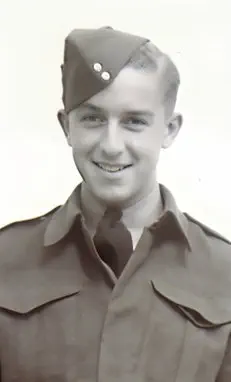
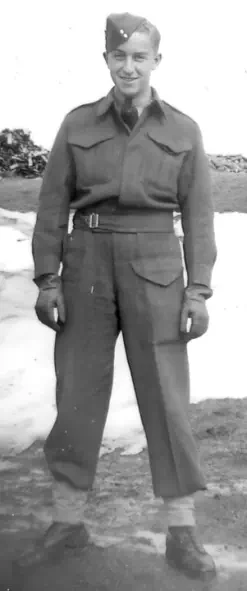
Augustine John Burke

Remembering World War II
Name:
Augustine John Burke
Rank:
Private
Service Number:
F/57767
Service:
North Nova Scotia Highlanders Regiment,
Royal Canadian Infantry Corps
Date of Birth:
August 26, 1925
Place of Birth:
River Bourgeois, Richmond Co., Nova Scotia
Date of Enlistment:
November 25, 1943
Place of Enlistment:
Halifax Co., NS
Address at Enlistment:
River Bourgeois, Richmond Co., Nova Scotia
Age at Enlistment:
18
Height:
5 feet, 8 ½ inches
Eye Colour:
Brown
Hair Colour:
Brown
Occupation:
Cook, Cdn National Railways, Halifax
Marital Status:
Single
Religion:
Roman Catholic
Next of Kin:
Alice Burke (Mother)
Date of Death:
February 22, 1945
Age:
19
Cemetery:
Groesbeek Canadian War Cemetery, Netherlands
Grave:
Section XI, Row A, Grave 12
Commemorated on Page 500 of the Second World War Book of Remembrance
Displayed in the Memorial Chamber of the Peace Tower in Ottawa on October 24
Augustine was the son of Son of Maurice ‘Morris’ Henri Burke (1888-1961) and Alice Rose (Bouchard)
Burke (b. 1894), of Cannes in Richmond Co., Nova Scotia. His siblings were Aloysius Louis (1922-1998),
Maria Alina (Phyllis), Ronald (b. 1924), Marie Pauline (1928-2018), Leonard Anthony (b. 1930), and Joseph
Maurice.
Augustine’s mother was born in Newfoundland and married Maurice in New Glasgow, NS in 1921.
Augustine’s grandfather was Louis Odilon Bourque (1847-1922).
Aloysius Burke, Augustine John's older brother, also served in the Canadian Army and survived a
torpedo attack on the SS Caribou. This passenger boat, built in the Netherlands in 1925, participated
in convoys between Nova Scotia and Newfoundland. A German submarine attacked the convoy on October
14, 1942, and the Caribou was sunk. On that Wednesday morning 136 people did not survive this attack in
the icy water.
After enlisting in August 1943, Augustine completed his basic training at the Canadian Infantry Basic
Training Centre No. 60 (Camp 60) in Yarmouth, NS, where he trained from December 10, 1943, to
February 12, 1944. He received Christmas leave from December 22 to 26, 1943.
Upon completing his basic training, he was transferred to Canadian Advanced Infantry Training Centre A14
at Aldershot in Kings Co., NS, and later granted pre‑embarkation leave during the summer of 1944. In
September of that year, he was posted to the No. 1 Training Brigade Group at Debert, Nova Scotia.
Augustine departed Canada on October 14, 1944, arriving in the
United Kingdom on October 20. He was subsequently transferred
from England to North‑West Europe on November 24, 1944.
In February 1945, the North Nova Scotia Highlanders were heavily
engaged in Operation Veritable, the Allied offensive to clear the
area between the Roer and Rhine rivers. The battalion fought
through flooded terrain, poor roads, and constant artillery and
mortar fire as they advanced toward German positions near
Emmerich and the surrounding villages. Despite mechanical failures
with their Buffalo amphibious vehicles and repeated delays caused
by rising water, the North Novas continued relieving units, holding
ground, and preparing for counterattacks. On February 22, they
were ordered to retake territory lost during a German
counter‑offensive, launching a coordinated attack with support
from several Canadian and British units. Under intense enemy
artillery fire, A and C Companies succeeded in reaching their
objectives and restoring the line. The fighting was costly, and nine
soldiers were killed that day, including Private Augustine John
Burke.
Following his death, Augustine was first laid to rest in Bedburg,
near the German city of Kalkar. On September 19, 1945, he was
reinterred at the Groesbeek Canadian War Cemetery, where he
now rests in Section XI, Row A, Grave 12.
Sources:
Service File - Augustine John Burke






- World War I - Menu
- WWI Stories and Articles
- Photos - Yarmouth Soldiers
- Selection of World War I Songs
- WWI Casualties of Yarmouth, NS
- Those Who Served - Yarmouth, NS
- WWI Casualties Digby Co. NS
- WWI Casualties Shelburne Co. NS
- Merchant Mariners (1915) Yarmouth, NS
- Canadian Forestry Corps - Non Yarmouth Birth/Residence Enlistments
- US Draft Registry - Yarmouth NS Born


- World War II - Menu
- WWII Stories and Articles
- Telegraphist Air Gunners
- WWII Casualties of Nova Scotia
- US Casualties with NS Connection
- Far East/Pacific Casualties with NS Connection
- Merchant Navy Casualties Nova Scotia
- Nova Scotia WWII Casualties Holten Canadian War Cemetery
- D-Day Casualties - Nova Scotia
- CANLOAN Program Casualties - Nova Scotia
- Battle of the Bulge Casualties - Nova Scotia
- WWII Casualties Yarmouth NS
- Yarmouth Casualties - RCAF RAF Canadian Army WWII
- Yarmouth Co., Marriages WWII
- Casualties Non-Born/Residents with Connection to Yarmouth Co., Nova Scotia.
- WWII Casualties Digby Co., NS
- Non-Nova Scotian WWII Casualties Buried in Nova Scotia
- WWII RCAF Casualties Aged 16-18
- Brothers/Sisters Who Served - World War II